Appearance
Edit and Delete Tasks
The new task page renders its form fields directly. As soon as the edit page is needed, those fields would have to be duplicated. In this chapter we'll extract them into a shared component, refactor the new task page to use it, and then build the edit page on top.
Eight files change, two are new[1]:
sh
doable/
└── client/
    └── src/
        ├── api.gleam                    # patch, delete added
        ├── route.gleam                  # EditTask route
        ├── router.gleam                 # EditTaskPage wired in
        ├── service/
        │   └── task_service.gleam       # fetch_task, patch, delete added
        ├── component/
        │   └── task_form.gleam          # shared form fields
        └── page/
            ├── tasks.gleam              # toggle added, edit links
            ├── new_task.gleam           # refactored to use task_form
            └── edit_task.gleam          # edit task page
Shared Form Component
component/task_form.gleam defines the form fields that both pages share. Crucially, it only handles field input — no submit button, no error display, no title. Those belong to the pages themselves, because each page has different buttons and different context:
gleam
// client/src/component/task_form.gleam

pub type Msg {
  UserUpdatedName(String)
  UserUpdatedDescription(String)
  UserUpdatedCompleted(Bool)
}

pub fn view(
  name: String,
  description: String,
  completed: Option(Bool),
) -> Element(Msg) {
  html.div([], [
    html.div([], [
      html.label([], [element.text("Name")]),
      html.input([
        attribute.type_("text"),
        attribute.placeholder("Task name"),
        attribute.value(name),
        event.on_input(UserUpdatedName),
      ]),
    ]),
    html.div([], [
      html.label([], [element.text("Description")]),
      html.textarea(
        [
          attribute.placeholder("Optional description"),
          event.on_input(UserUpdatedDescription),
        ],
        description,
      ),
    ]),
    case completed {
      None -> element.none()
      Some(value) ->
        html.label([], [
          html.input([
            attribute.type_("checkbox"),
            attribute.checked(value),
            event.on_check(UserUpdatedCompleted),
          ]),
          element.text("Completed"),
        ])
    },
  ])
}
The completed parameter being Option(Bool) is the key design decision. The completed checkbox is only meaningful when editing an existing task — a new task is always incomplete. Passing None hides the checkbox entirely; Some(value) shows it with the current state.
Refactoring New Task
Now that the form component exists, new_task.gleam removes its inline fields and delegates to it. The Msg type changes to wrap form messages:
gleam
// client/src/page/new_task.gleam

pub type Msg {
  FormMsg(task_form.Msg)
  UserSubmittedForm
  UserClickedBack
  ApiCreatedTask(Result(Task, ApiError))
}
update handles each form message through the FormMsg wrapper. UserUpdatedCompleted is explicitly handled and ignored — the checkbox never appears on this page, but exhaustive matching still requires covering it:
gleam
// client/src/page/new_task.gleam

pub fn update(model: Model, msg: Msg) -> #(Model, Effect(Msg)) {
  case msg {
    FormMsg(UserUpdatedName(name)) -> #(Model(..model, name:), effect.none())
    FormMsg(UserUpdatedDescription(description)) -> #(
      Model(..model, description:),
      effect.none(),
    )
    FormMsg(UserUpdatedCompleted(_)) -> #(model, effect.none())
    ...
  }
}
view replaces the inline fields with a single task_form.view call. element.map(FormMsg) wraps every message the component emits so it fits into the page's Msg type:
gleam
// client/src/page/new_task.gleam

pub fn view(model: Model) -> Element(Msg) {
  html.div([], [
    html.h1([], [element.text("New Task")]),
    case model.error {
      None -> element.none()
      Some(err) -> html.p([], [element.text(err)])
    },
    task_form.view(model.name, model.description, None)
      |> element.map(FormMsg),
    html.div([], [
      html.button(
        [attribute.disabled(model.submitting), event.on_click(UserSubmittedForm)],
        [
          element.text(case model.submitting {
            True -> "Saving..."
            False -> "Save"
          }),
        ],
      ),
      html.button([event.on_click(UserClickedBack)], [element.text("Back")]),
    ]),
  ])
}
The submit and back buttons stay in the page rather than moving into the form — the edit page will have a delete button too, and the form component shouldn't need to know about that.
Patch and Delete Methods
api.gleam gains two new functions. patch mirrors post but expects a 200 response:
gleam
// client/src/api.gleam

pub fn patch(
  path: String,
  decoder: Decoder(a),
  json body: String,
) -> Promise(Result(a, ApiError)) {
  use req <- with_json_request(path)
  req
  |> request.set_method(Patch)
  |> request.set_header("content-type", "application/json")
  |> request.set_body(body)
  |> execute(expect: 200, decoder:)
}
delete is different — it expects no response body, so there is nothing to decode:
gleam
// client/src/api.gleam

pub fn delete(path: String) -> Promise(Result(Nil, ApiError)) {
  use request <- with_json_request(path)
  request
  |> request.set_method(Delete)
  |> fetch.send
  |> promise.map(result.map_error(_, FetchError))
  |> promise.map_try(fn(response) {
    use <- bool.guard(
      response.status != 204,
      Error(UnexpectedStatus(response.status)),
    )
    Ok(Nil)
  })
}
bool.guard provides an early-return pattern: if the condition is true it returns the first argument; otherwise it evaluates the second. Here it returns an error if the status isn't 204 No Content, and Ok(Nil) otherwise.
Extending the Task Service
With api.patch and api.delete in place, task_service.gleam gains the three operations the edit page needs. The full module now covers every task API call in one place:
gleam
// client/src/service/task_service.gleam

pub fn fetch_tasks() -> Promise(Result(List(Task), ApiError)) {
  "/api/tasks"
  |> api.get(decode.list(task.task_decoder()))
}

pub fn fetch_task(task_id: Int) -> Promise(Result(Task, ApiError)) {
  let path = "/api/tasks/" <> int.to_string(task_id)
    path
    |> api.get(task.task_decoder())
}

pub fn post_task(input: TaskInput) -> Promise(Result(Task, ApiError)) {
  let body =
    input
    |> task.task_input_to_json
    |> json.to_string

  "/api/tasks"
  |> api.post(task.task_decoder(), json: body)
}

pub fn patch_task(task: Task) -> Promise(Result(Task, ApiError)) {
  let body =
    task
    |> task.to_task_input
    |> task.task_input_to_json
    |> json.to_string
  let path = "/api/tasks/" <> int.to_string(task.id)
  path
  |> api.patch(task.task_decoder(), json: body)
}

pub fn delete_task(task_id: Int) -> Promise(Result(Nil, ApiError)) {
  let path = "/api/tasks/" <> int.to_string(task_id)
  path
  |> api.delete
}
fetch_task mirrors fetch_tasks but targets a single task by ID. patch_task accepts the full Task record, converts it to TaskInput for serialization, then delegates to api.patch. delete_task only needs the ID — no body to build.
Extending the Routes
route.gleam adds the edit route. EditTask carries the task ID directly in the route type, so the page gets everything it needs from the URL:
gleam
// client/src/route.gleam

pub type Route {
  Tasks
  NewTask
  EditTask(Int)
}

pub fn to_path(route: Route) -> String {
  case route {
    Tasks -> "/tasks"
    NewTask -> "/tasks/new"
    EditTask(id) -> "/tasks/" <> int.to_string(id) <> "/edit"
  }
}

pub fn from_uri(uri: Uri) -> Route {
  case uri.path_segments(uri.path) {
    ["tasks"] -> Tasks
    ["tasks", "new"] -> NewTask
    ["tasks", id, "edit"] ->
      int.parse(id)
      |> result.map(EditTask)
      |> result.unwrap(home_route)
    _ -> home_route
  }
}
from_uri parses the URL segment with int.parse and falls back to home_route if it isn't a valid integer. The compiler now requires every case route expression to handle EditTask, so nothing can be left unwired.
The Edit Task Page
page/edit_task.gleam needs to fetch the task before the form can be shown. Rather than using a union type for loading state, the model uses a flat record with a loading flag — the task fields are always accessible, and the view switches on loading to decide what to render:
gleam
// client/src/page/edit_task.gleam

pub type Model {
  Model(task: Task, loading: Bool, submitting: Bool, error: Option(String))
}

pub type Msg {
  FormMsg(task_form.Msg)
  UserSubmittedForm
  UserClickedDelete
  UserClickedBack
  ApiReturnedTask(Result(Task, ApiError))
  ApiUpdatedTask(Result(Task, ApiError))
  ApiDeletedTask(Result(Nil, ApiError))
}
Seven messages cover the full lifecycle of the page:
FormMsg— wraps field changes emitted by the form componentUserSubmittedForm— save button clickedUserClickedDelete— delete button clickedUserClickedBack— back navigationApiReturnedTask— result of the initial fetchApiUpdatedTask— result of the PATCH requestApiDeletedTask— result of the DELETE request
init starts with a placeholder task and immediately fires the fetch:
gleam
// client/src/page/edit_task.gleam

pub fn init(task_id: Int) -> #(Model, Effect(Msg)) {
  #(
    Model(
      task: Task(id: task_id, name: "", description: "", completed: False),
      loading: True,
      submitting: False,
      error: None,
    ),
    fetch_task(task_id),
  )
}
Storing the task ID in the placeholder task avoids threading it separately through the model — fetch_task reads it, and the path construction functions can use model.task.id without special-casing the loading state.
update handles all messages and uses the task.Task(..task, field:) spread syntax to update individual fields on the nested task record:
gleam
// client/src/page/edit_task.gleam

pub fn update(model: Model, msg: Msg) -> #(Model, Effect(Msg)) {
  case msg {
    FormMsg(UserUpdatedName(name)) -> #(
      Model(..model, task: Task(..model.task, name:)),
      effect.none(),
    )
    FormMsg(UserUpdatedDescription(description)) -> #(
      Model(..model, task: Task(..model.task, description:)),
      effect.none(),
    )
    FormMsg(UserUpdatedCompleted(completed)) -> #(
      Model(..model, task: Task(..model.task, completed:)),
      effect.none(),
    )
    UserSubmittedForm ->
      case model.task.name {
        "" -> #(Model(..model, error: Some("Name is required")), effect.none())
        _ -> #(
          Model(..model, submitting: True, error: None),
          patch_task(model.task),
        )
      }
    UserClickedDelete -> #(
      Model(..model, submitting: True),
      delete_task(model.task.id),
    )
    UserClickedBack -> #(model, effect.from(fn(_) { browser.history_back() }))
    ApiReturnedTask(Ok(task)) -> #(
      Model(..model, task:, loading: False),
      effect.none(),
    )
    ApiReturnedTask(Error(err)) -> #(
      Model(..model, loading: False, error: Some(error.message(err))),
      effect.none(),
    )
    ApiUpdatedTask(Ok(_)) -> #(
      model,
      modem.push(route.to_path(route.Tasks), None, None),
    )
    ApiUpdatedTask(Error(err)) -> #(
      Model(..model, submitting: False, error: Some(error.message(err))),
      effect.none(),
    )
    ApiDeletedTask(Ok(_)) -> #(
      model,
      modem.push(route.to_path(route.Tasks), None, None),
    )
    ApiDeletedTask(Error(err)) -> #(
      Model(..model, submitting: False, error: Some(error.message(err))),
      effect.none(),
    )
  }
}
Both ApiUpdatedTask(Ok(_)) and ApiDeletedTask(Ok(_)) navigate back to the tasks list. The delete button sets submitting: True before firing the request so both buttons are disabled during the operation — preventing a double-submit or a delete while a save is in flight.
view switches on model.loading:
gleam
// client/src/page/edit_task.gleam

pub fn view(model: Model) -> Element(Msg) {
  case model.loading {
    True -> html.p([], [element.text("Loading...")])
    False ->
      html.div([], [
        html.h1([], [element.text("Edit Task")]),
        case model.error {
          None -> element.none()
          Some(err) -> html.p([], [element.text(err)])
        },
        task_form.view(
          model.task.name,
          model.task.description,
          Some(model.task.completed),
        )
          |> element.map(FormMsg),
        html.div([], [
          html.button(
            [attribute.disabled(model.submitting), event.on_click(UserSubmittedForm)],
            [
              element.text(case model.submitting {
                True -> "Saving..."
                False -> "Save"
              }),
            ],
          ),
          html.button(
            [attribute.disabled(model.submitting), event.on_click(UserClickedDelete)],
            [element.text("Delete")],
          ),
          html.button([event.on_click(UserClickedBack)], [element.text("Back")]),
        ]),
      ])
  }
}
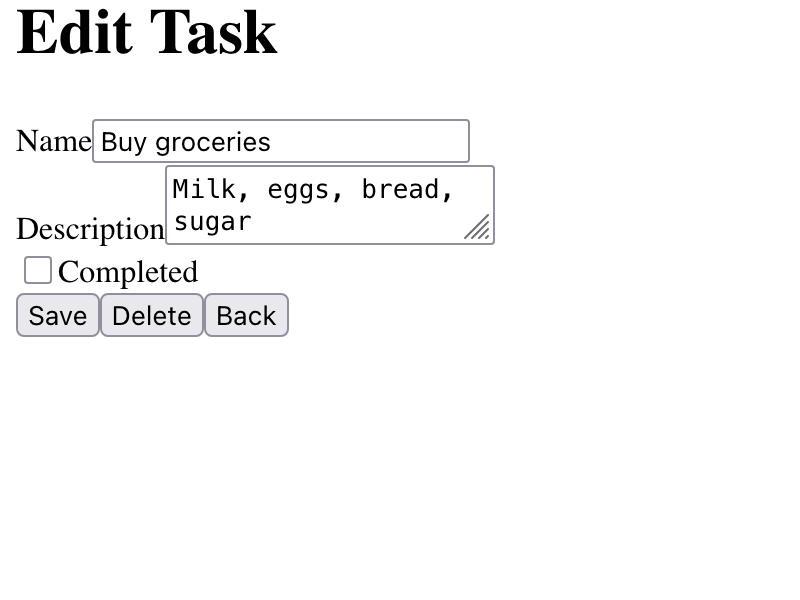
Some(model.task.completed) passes the current completion state to the form, so the checkbox appears and reflects the real value. The delete button is disabled alongside the save button — submitting guards both.
The three private effects delegate to the task service and follow the same use dispatch <- effect.from pattern:
gleam
// client/src/page/edit_task.gleam

fn fetch_task(task_id: Int) -> Effect(Msg) {
  use dispatch <- effect.from
  task_service.fetch_task(task_id)
  |> promise.map(ApiReturnedTask)
  |> promise.tap(dispatch)
  Nil
}

fn patch_task(task: Task) -> Effect(Msg) {
  use dispatch <- effect.from
  task_service.patch_task(task)
  |> promise.map(ApiUpdatedTask)
  |> promise.tap(dispatch)
  Nil
}

fn delete_task(task_id: Int) -> Effect(Msg) {
  use dispatch <- effect.from
  task_service.delete_task(task_id)
  |> promise.map(ApiDeletedTask)
  |> promise.tap(dispatch)
  Nil
}
Wiring the Router
router.gleam gains the final page variant and message:
gleam
// client/src/router.gleam

pub type Page {
  TasksPage(tasks.Model)
  NewTaskPage(new_task.Model)
  EditTaskPage(edit_task.Model)
}

pub type Msg {
  OnRouteChanged(route.Route)
  TasksPageSentMsg(tasks.Msg)
  NewTaskPageSentMsg(new_task.Msg)
  EditTaskPageSentMsg(edit_task.Msg)
}
update gains a matching branch, and view delegates to the edit page's view function:
gleam
// client/src/router.gleam

pub fn update(page: Page, msg: Msg) -> #(Page, Effect(Msg)) {
  case msg, page {
    OnRouteChanged(route), _ -> page_from_route(route)
    TasksPageSentMsg(page_msg), TasksPage(page_model) -> {
      let #(new_page_model, effect) = tasks.update(page_model, page_msg)
      #(TasksPage(new_page_model), effect.map(effect, TasksPageSentMsg))
    }
    NewTaskPageSentMsg(page_msg), NewTaskPage(page_model) -> {
      let #(new_page_model, effect) = new_task.update(page_model, page_msg)
      #(NewTaskPage(new_page_model), effect.map(effect, NewTaskPageSentMsg))
    }
    EditTaskPageSentMsg(page_msg), EditTaskPage(page_model) -> {
      let #(new_page_model, effect) = edit_task.update(page_model, page_msg)
      #(EditTaskPage(new_page_model), effect.map(effect, EditTaskPageSentMsg))
    }
    _, _ -> panic as "mismatched msg and page"
  }
}

pub fn view(page: Page) -> Element(Msg) {
  case page {
    TasksPage(page_model) ->
      tasks.view(page_model) |> element.map(TasksPageSentMsg)
    NewTaskPage(page_model) ->
      new_task.view(page_model) |> element.map(NewTaskPageSentMsg)
    EditTaskPage(page_model) ->
      edit_task.view(page_model) |> element.map(EditTaskPageSentMsg)
  }
}
page_from_route maps the edit route to the page. The task ID flows directly from the URL into edit_task.init, which fires the fetch — no global state, no context:
gleam
// client/src/router.gleam

fn page_from_route(route: route.Route) -> #(Page, Effect(Msg)) {
  case route {
    route.Tasks -> {
      let #(page_model, effect) = tasks.init()
      #(TasksPage(page_model), effect.map(effect, TasksPageSentMsg))
    }
    route.NewTask -> {
      let #(page_model, effect) = new_task.init()
      #(NewTaskPage(page_model), effect.map(effect, NewTaskPageSentMsg))
    }
    route.EditTask(id) -> {
      let #(page_model, effect) = edit_task.init(id)
      #(EditTaskPage(page_model), effect.map(effect, EditTaskPageSentMsg))
    }
  }
}
Toggling Task Completion
tasks.gleam gains two new messages and a new effect so completion can be toggled inline without leaving the list.
Two new Msg variants handle the toggle lifecycle. UserToggledTask carries the task and the new completion state as a Bool — the value comes straight from the checkbox event rather than being derived from the model:
gleam
// client/src/page/tasks.gleam

pub type Msg {
  ApiReturnedTasks(Result(List(Task), ApiError))
  UserToggledTask(Task, Bool)
  ApiUpdatedTask(Result(Task, ApiError))
}
update handles both, using result.map and list.map to swap the updated task in place — no full refetch needed:
gleam
// client/src/page/tasks.gleam

    UserToggledTask(task, completed) -> #(model, toggle_task(task, completed))
    ApiUpdatedTask(Ok(updated)) -> #(
      Model(
        ..model,
        tasks: result.map(
          model.tasks,
          list.map(_, fn(t) {
            case t.id == updated.id {
              True -> updated
              False -> t
            }
          }),
        ),
      ),
      effect.none(),
    )
    ApiUpdatedTask(Error(_)) -> #(model, effect.none())
toggle_task applies the new completion state and PATCHes it via the service:
gleam
// client/src/page/tasks.gleam

fn toggle_task(task: Task, completed: Bool) -> Effect(Msg) {
  use dispatch <- effect.from
  task_service.patch_task(Task(..task, completed:))
  |> promise.map(ApiUpdatedTask)
  |> promise.tap(dispatch)
  Nil
}
toggle_task takes the new Bool value directly from the checkbox event rather than flipping !task.completed from the closure — this avoids stale state if the checkbox is clicked before a previous PATCH response arrives. Task(..task, completed:) uses record spread to produce a copy with just the one field updated.
Edit Links in the Tasks List
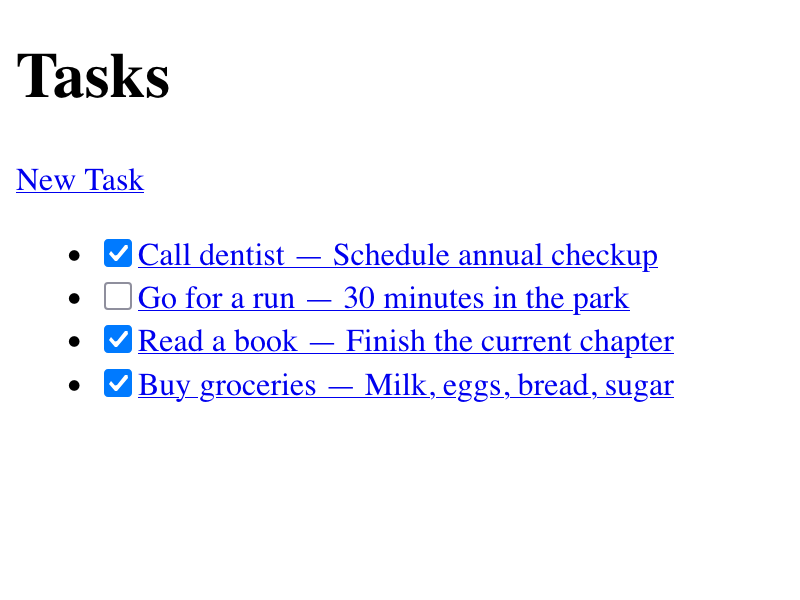
Each task item becomes a separate checkbox and link. Keeping them apart means clicking the checkbox toggles completion while clicking the text navigates to the edit page — two independent interactions on the same row:
gleam
// client/src/page/tasks.gleam

fn view_task(task: Task) -> Element(Msg) {
  html.li([], [
    html.input([
      attribute.type_("checkbox"),
      attribute.checked(task.completed),
      event.on_check(fn(checked) { UserToggledTask(task, checked) }),
    ]),
    html.a([attribute.href(route.to_path(route.EditTask(task.id)))], [
      element.text(task.name <> " — " <> task.description),
    ]),
  ])
}
event.on_check passes the new boolean directly into UserToggledTask. The link delegates URL construction to route.to_path, consistent with every other navigation in the app.
What's Next
The CRUD loop is complete — list, create, edit, delete all work. The app is fully functional, just unstyled. Next, we'll plug in Tailwind CSS, DaisyUI, and Heroicons to give it a proper look and feel.