Appearance
Tasks Screen
With the Lustre skeleton in place, it's time to replace the greeting app with the real task UI. In this chapter we'll fetch tasks from the API and render them as a list — introducing effects, a dedicated HTTP client, and error handling along the way[1].
Six files change, four are new:
sh
doable/
└── client/
    ├── gleam.toml              # 4 new deps + dev proxy config
    └── src/
        ├── error.gleam         # ApiError type
        ├── api.gleam           # HTTP client
        ├── browser.gleam       # window.location.origin FFI
        ├── browser_ffi.js      # FFI implementation
        └── client.gleam        # tasks screen
Install Dependencies
Making HTTP requests from the browser requires four packages:
sh
cd client
gleam add gleam_http gleam_fetch gleam_javascript gleam_json
gleam.toml gains four new entries:
toml
# client/gleam.toml

[dependencies]
shared = { path = "../shared" }
gleam_stdlib = ">= 0.44.0 and < 2.0.0"
gleam_javascript = ">= 1.0.0 and < 2.0.0"
gleam_json = ">= 3.1.0 and < 4.0.0"
gleam_http = ">= 4.0.0 and < 5.0.0"
gleam_fetch = ">= 1.3.0 and < 2.0.0"
lustre = ">= 5.6.0 and < 6.0.0"- gleam_http — shared request and response types used across Gleam's HTTP ecosystem.
- gleam_fetch — a thin wrapper around the browser's native Fetch API.
- gleam_javascript — exposes browser primitives, including
Promise. - gleam_json — JSON decoding, shared with the server and
sharedpackages.
Error Handling
A new error.gleam module defines all the ways an API call can fail:
gleam
// client/src/error.gleam

import gleam/dynamic/decode
import gleam/fetch
import gleam/int

pub type ApiError {
  InvalidUrl(url: String)
  UnexpectedStatus(status: Int)
  FetchError(fetch.FetchError)
  DecodeError(List(decode.DecodeError))
}

pub fn message(error: ApiError) -> String {
  case error {
    InvalidUrl(url) -> "Invalid URL: " <> url
    UnexpectedStatus(status) -> "Unexpected status: " <> int.to_string(status)
    FetchError(fetch.NetworkError(detail)) -> "Network error: " <> detail
    FetchError(fetch.UnableToReadBody) -> "Unable to read response body"
    FetchError(fetch.InvalidJsonBody) -> "Response is not valid JSON"
    DecodeError(_) -> "Failed to decode response"
  }
}
ApiError covers every failure the API client can produce:
InvalidUrl— the URL string couldn't be parsed into a request.UnexpectedStatus— the server responded with a status code outside the expected set.FetchError— a network-level failure fromgleam_fetch.DecodeError— the response body didn't match the expected JSON shape.
The message helper turns any error into a human-readable string. All the pattern matching happens here, once — the view just calls error.message(err).
The API Client
api.gleam provides a single public function, get, that sends a JSON request and decodes the response:
gleam
// client/src/api.gleam

import error.{
  type ApiError, DecodeError, FetchError, InvalidUrl, UnexpectedStatus,
}
import gleam/bool
import gleam/dynamic/decode.{type Decoder}
import gleam/fetch
import gleam/http.{Get}
import gleam/http/request.{type Request}
import gleam/javascript/promise.{type Promise}
import gleam/result

pub fn get(path: String, decoder: Decoder(a)) -> Promise(Result(a, ApiError)) {
  use req <- with_json_request(path)
  req
  |> request.set_method(Get)
  |> execute(expect: 200, decoder:)
}
get takes a path and a decoder, and returns a Promise that resolves to either the decoded value or an ApiError.
Building the Request
with_json_request constructs a base request or returns early if the URL is invalid:
gleam
// client/src/api.gleam

import browser

fn api_base_url() -> String {
  browser.window_location_origin()
}

fn with_json_request(
  path: String,
  callback: fn(Request(String)) -> Promise(Result(b, ApiError)),
) -> Promise(Result(b, ApiError)) {
  let url = api_base_url() <> path
  request.to(url)
  |> result.replace_error(InvalidUrl(url))
  |> result.map(request.set_header(_, "accept", "application/json"))
  |> promise.resolve
  |> promise.try_await(callback)
}
api_base_url reads the page's own origin at runtime — http://localhost:1234 in dev, whatever the deployment URL is in production. The browser module is a thin FFI wrapper introduced a few sections below.
request.toparses the URL, returningError(Nil)on failure.result.replace_errorswaps that for a meaningfulInvalidUrl.result.mapadds theacceptheader to the request.promise.resolvelifts theResultinto a resolved promise so the rest of the chain can usepromise.try_await— which callscallbackonly onOk, and short-circuits with the error otherwise.
Executing the Request
gleam
// client/src/api.gleam

fn execute(
  req: Request(String),
  expect expect: Int,
  decoder decoder: Decoder(a),
) -> Promise(Result(a, ApiError)) {
  req
  |> fetch.send
  |> promise.try_await(fetch.read_json_body)
  |> promise.map(result.map_error(_, FetchError))
  |> promise.map_try(fn(response) {
    use <- bool.guard(
      response.status != expect,
      Error(UnexpectedStatus(response.status)),
    )
    response.body
    |> decode.run(decoder)
    |> result.map_error(DecodeError)
  })
}
The pipeline sends the request and processes the response in four steps:
fetch.senddispatches the request and returns a promise of a raw response.fetch.read_json_bodyreads and parses the body as JSON;promise.try_awaitshort-circuits if reading fails.promise.mapwraps anyfetch.FetchErrorinto ourApiErrortype.promise.map_tryvalidates the status code withbool.guard— which returns its second argument early if the condition is true — then decodes the body with the provided decoder.
Enabling Effects
The greeting app used lustre.simple, which only allows pure state updates. To make HTTP requests, client.gleam upgrades to lustre.application:
gleam
// client/src/client.gleam

pub fn main() {
  let app = lustre.application(init, update, view)
  let assert Ok(_) = lustre.start(app, "#app", Nil)
}
With lustre.simple, init returns Model and update returns Model. With lustre.application, both return #(Model, Effect(Msg)) — a tuple pairing the new model with an optional side effect to run. Effects run outside the pure update function and feed their results back in as messages.
┌───▶ User interaction
│           │
│           ▼
│        Message ◀──────────────────┐
│           │                       │
│           ▼                       │
│   update(model, msg) ──▶ Effect   │
│           │               │       │
│           ▼               ▼       │
│        new Model     Effect runs  │
│           │          (HTTP, …)    │
│           ▼               │       │
│      view(model)          └───────┘
│           │
│           ▼
└──────────HTML
Model and Messages
The model now holds the task list and a loading flag:
gleam
// client/src/client.gleam

pub type Model {
  Model(tasks: Result(List(Task), ApiError), loading: Bool)
}

pub type Msg {
  ApiReturnedTasks(Result(List(Task), ApiError))
}
tasks is a Result — it holds either a list of tasks or the error that prevented fetching them. loading tracks whether a fetch is in flight; it's separate from tasks so the loading state is readable independently of whether there's already data.
Msg has a single variant. Following Lustre's subject-verb-object convention, ApiReturnedTasks names the source (Api) and the event (ReturnedTasks).
Fetching on Init
init starts a fetch immediately:
gleam
// client/src/client.gleam

pub fn init(_) -> #(Model, Effect(Msg)) {
  #(Model(tasks: Ok([]), loading: True), fetch_tasks())
}

fn fetch_tasks() -> Effect(Msg) {
  use dispatch <- effect.from
  api.get("/api/tasks", decode.list(task.task_decoder()))
  |> promise.map(ApiReturnedTasks)
  |> promise.tap(dispatch)
  Nil
}
effect.from creates an effect from a callback that receives dispatch — the function that sends messages back into the MVU loop. Inside the callback, api.get returns a promise; promise.map wraps the result in ApiReturnedTasks; promise.tap calls dispatch with that message when the promise resolves, without consuming the value. The trailing Nil satisfies Gleam's requirement that every function returns a value — effect.from ignores it.
Update
update handles the single message:
gleam
// client/src/client.gleam

pub fn update(_model: Model, msg: Msg) -> #(Model, Effect(Msg)) {
  case msg {
    ApiReturnedTasks(Ok(tasks)) -> #(
      Model(tasks: Ok(tasks), loading: False),
      effect.none(),
    )
    ApiReturnedTasks(Error(err)) -> #(
      Model(tasks: Error(err), loading: False),
      effect.none(),
    )
  }
}
The previous model is ignored for now (_model) — the response carries the full new state. Both branches set loading: False — the fetch has settled regardless of outcome. effect.none() signals that no further side effects are needed.
View
gleam
// client/src/client.gleam

pub fn view(model: Model) -> Element(Msg) {
  html.div([], [
    html.h1([], [element.text("Tasks")]),
    case model.tasks {
      Error(err) -> html.p([], [element.text(error.message(err))])
      Ok([]) if model.loading -> html.p([], [element.text("Loading...")])
      Ok([]) -> html.p([], [element.text("No tasks yet")])
      Ok(tasks) -> html.ul([], list.map(tasks, view_task))
    },
  ])
}

fn view_task(task: Task) -> Element(Msg) {
  html.li([], [
    html.input([
      attribute.type_("checkbox"),
      attribute.checked(task.completed),
      attribute.disabled(True),
    ]),
    element.text(task.name <> " — " <> task.description),
  ])
}
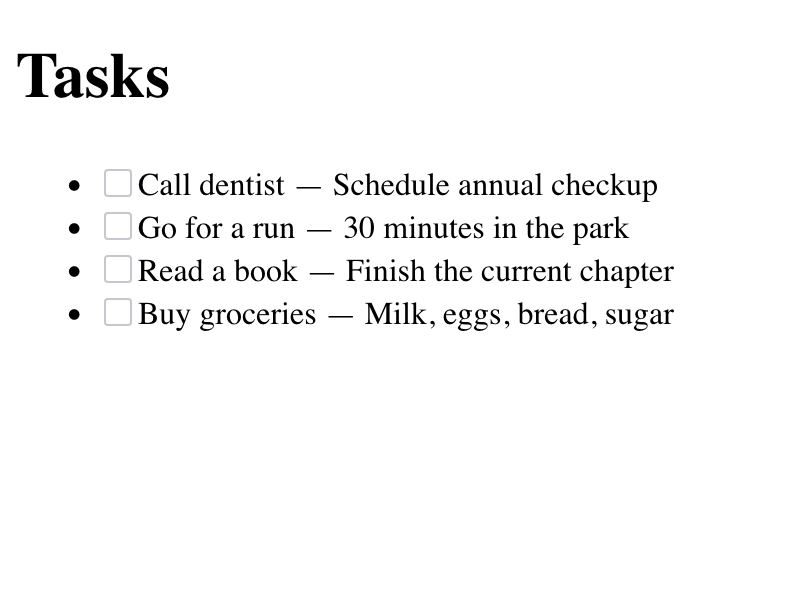
The case on model.tasks covers all four states:
- Error — display the error message via
error.message. Ok([]) if model.loading— the list is empty and a fetch is in flight: show "Loading…". The guard clause distinguishes this from an empty list that has already loaded.Ok([])— fetch complete but no tasks: "No tasks yet".Ok(tasks)— render the list.
view_task renders each task as a list item with a read-only checkbox. The checkbox reflects the task's completed state but attribute.disabled(True) prevents interaction for now.
Browser FFI
api_base_url reaches for window.location.origin, which isn't in the Gleam standard library. A tiny FFI module bridges the gap:
gleam
// client/src/browser.gleam

@external(javascript, "./browser_ffi.js", "window_location_origin")
pub fn window_location_origin() -> String
js
// client/src/browser_ffi.js

export function window_location_origin() {
  return window.location.origin;
}
@external declares a Gleam function that's implemented in another language. The three arguments are the target (javascript), the module path relative to this file, and the exported function name. Callers use browser.window_location_origin() like any other Gleam function — the FFI boundary is invisible.
Proxying the API in Dev
window.location.origin returns http://localhost:1234 in dev — but the API runs on port 8000. Hitting it directly would be a cross-origin request, which the browser blocks by default.
lustre_dev_tools has a built-in dev proxy for exactly this situation. A small addition to gleam.toml tells it to forward /api/* requests to the Gleam server, and while we're here we set the page title too:
toml
# client/gleam.toml

[tools.lustre.html]
title = "Doable"

[tools.lustre.dev]
proxy = { from = "/api", to = "http://localhost:8000/api" }
The browser sends the request to the dev server (same origin — no CORS), the dev server relays it to localhost:8000, and the response flows back the same way.
INFO
CORS (Cross-Origin Resource Sharing) is a browser security mechanism that blocks requests between different origins by default. Proxying through the dev server keeps everything same-origin, so no Access-Control-Allow-* headers are needed on the server. In production the API and frontend are served from the same origin via Caddy, so the setup stays consistent.
What's Next
Tasks load from the API and render as a list — but the app is still one page crammed into client.gleam. Next, we'll carve it into modules: a Route type, a router, per-page files, and a task service so adding new screens doesn't mean bloating one file.